What Survives in Fifteen-Year-Old Voice Recordings?

I have been experimenting with the voice recordings from Wing Commander Saga, a free fan-made game I helped release in 2012. Most of the cast were hobby voice actors and Wing Commander fans who recorded at home on whatever gear they had. Fifteen years later I wanted to know two things: how much of that raw material still exists, and how much a careful restoration pass can get out of it.
Captain Moran's Episode 2 outro shows the problem. He is standing on a steel deck, but between his words the sound drops to digital silence. Under the picture you hear an edit every time he stops to breathe. The raw take for that scene is lost. I only found copies of the shipped edit, so that is what I worked with.
What survived
Most of the raw recordings did survive. The old project archive has 69 cast folders with about 40 hours of audio, alternate takes and copies included. I could match 81 percent of the 5,745 English voice lines in the game to a raw file, almost all by filename or line ID and 29 by comparing waveforms. A matching name does not guarantee the same reading, so I check every take against the game audio before I use it.
The quality varies a lot. Some recordings are very quiet, others have the room baked into them. I remember how lucky I felt when the recordings came in, and opening the archive again brought that back.
With a raw take I can still hear some of the top end the game file lost. The shipped files went through the original edit, mastering and Ogg Vorbis encoding. In Moran's command briefing, the usable frequency range drops from about 16 kHz in the raw take to about 13 kHz in the shipped file. The Baws comparison is less clean, because his briefing soundtrack also carries music and effects. I left in-flight lines out of this post: the game puts them through radio processing, so they say little about the recording itself.
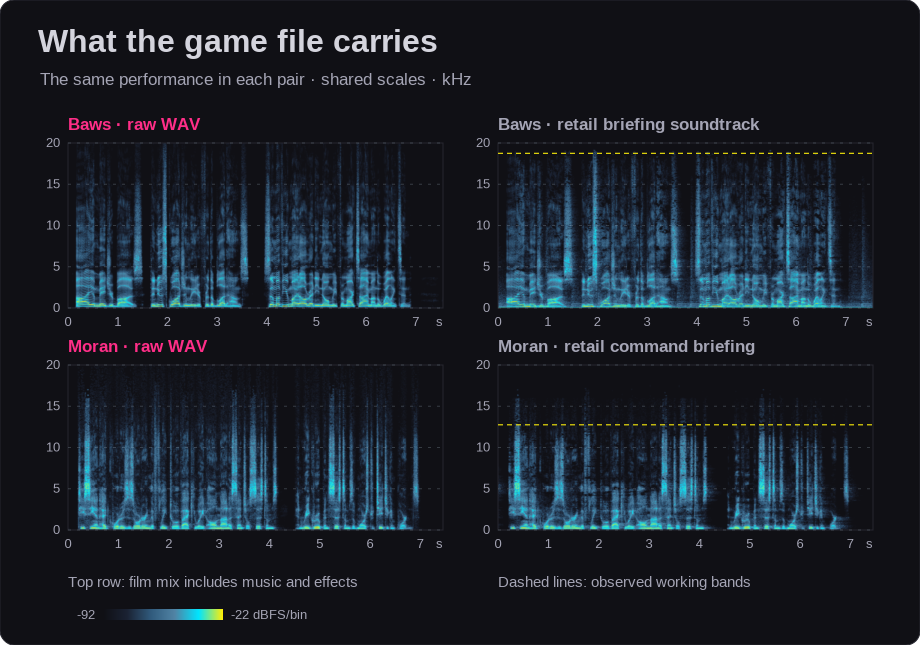
What is in the raw recordings
Before changing anything, I measured short excerpts from a dozen characters: the noise floor in the quiet parts (the tenth percentile of 100 ms RMS windows), hum near mains frequency, clipping, DC offset, stretches of digital silence and how the sound decays after words. Three briefing takes show the range well:
- Moran's command briefing is clean, with a noise floor around −74 dBFS.
- Baws's raw recording for the first briefing has a faint hum around 60 Hz.
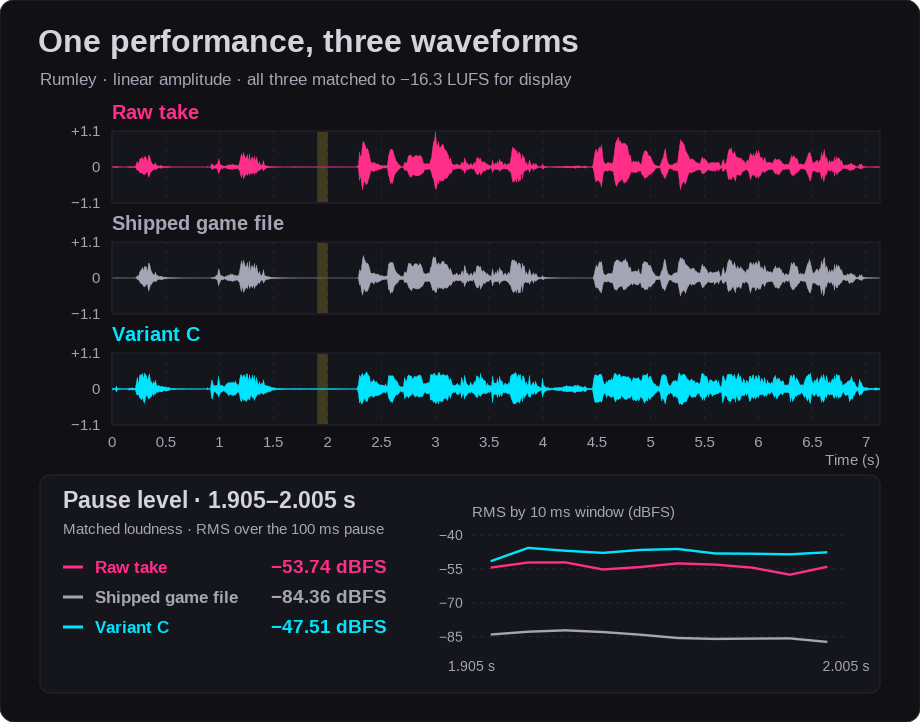
- Rumley's low mids sit about 16 dB above the upper speech band, and you can hear the room after his words.
The restoration pass
As with Moran's outro further down, I made four versions of the first Hermes briefing and picked version C, so I call this treatment Variant C. It is a studio restore followed by a short briefing-room reverb. All three examples below use it. Baws's clip is the voice from the finished first briefing. That version was made from the shipped voice master, because it has to keep the film's timing, so his before clip is that master. For Moran and Rumley I started from the matched raw takes. The treatment was set up on the shipped masters, which are louder, so I first raised each raw take to the speech level of its own master.
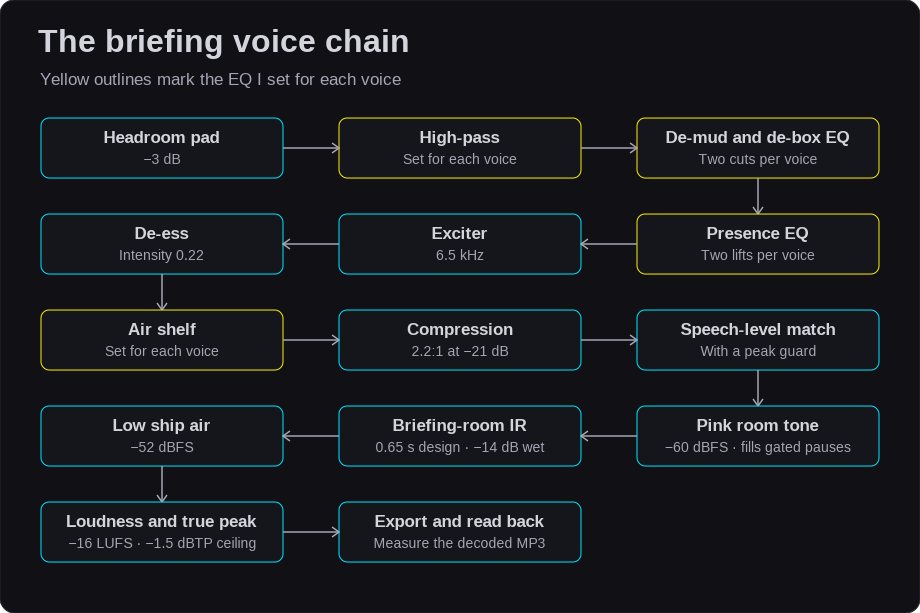
EQ. A 3 dB pad leaves headroom. A high-pass takes out the rumble, then I cut the heavy low mids and lift the range where the words need definition. This is the one stage I tune per voice. Baws got a 75 Hz high-pass, cuts at 200 and 400 Hz and a 3 dB lift at 3.2 kHz. Moran got an 85 Hz high-pass and a 2.5 dB lift around 1.4 kHz. Rumley, the boxiest of the three, got a 90 Hz high-pass, a cut of about 5 dB at 470 Hz and a lift at 3.3 kHz.

Top end. An exciter adds some brightness. The de-esser comes right after it, because the extra top end also sharpens the sibilants. A high shelf then adds air.

Dynamics. Gentle 2.2:1 compression evens out each line.
Room. A low pink room tone runs under the voice. In Baws's master it fills the holes the old gate left, so his pauses no longer drop to digital silence. Then comes a short briefing-room reverb with a 0.65-second decay, mixed at −14 dB, and a low bed of ship air. Each line ends up at −16 LUFS with a −1.5 dB true-peak ceiling. I check both after MP3 encoding, because encoding can push a peak up.
Back to Moran
For the outro I made four versions of the same excerpt against the same music:
- A: the original stem.
- B: the restored voice with light room tone under the gated pauses.
- C: B plus a steel-deck reverb, a 2.4-second impulse response at −11 dB.
- D: the same reverb at −5 dB.
I went with C. In the 7.7 seconds I measured, starting 7.5 seconds into the outro, the original stem has almost 0.7 seconds of digital silence. From A to C the balance between low mids and presence drops from +10.7 dB to +5.3 dB at the same loudness, about −16.6 LUFS with the music included. The players use a later part of the same scene, voice only.
Moran · Episode 2 outro, shipped stem against version C
Listen to the examples
The chart shows the sources at their original levels. In the players I matched each before clip to the restored level and limited peaks where I needed the headroom. All clips are voice only.

Moran · Command briefing, raw take against Variant C
Baws · First Hermes briefing, shipped voice master against Variant C
Rumley · Command briefing, raw take against Variant C
What I learned
Keep the raw take and the game export together. The export shows which performance was chosen and how it was cut. The raw file shows what was recorded before anyone processed it. And once a treatment works for one briefing, it carries to the others. Only the input level and the EQ had to change from voice to voice.
Thank you again to the cast. These are still your performances. Hearing a familiar line come out of its original recording was the best part of this experiment. Is there a voice or a briefing you remember particularly well? I would like to know what stuck with you.
Until next time.